Oh boy. Here we go.
The document got a lot of attention since my last post. It's still not done, but it's done enough for the defense. And I'm starting that in 75 minutes.
Fingers crossed.
Monday, August 6, 2018


Sunday, July 22, 2018
Day 17: Barreling toward the finsh
The mission today was Chapter 6. I took the chapter from 5552 words up to 6868. But that obfuscates the rewriting I did all along the way. It was much more work than 1316 new words over 4 hours. (Although that is a fairly typical writing pace for me, now that I think about it.)
This chapter had a lot of previous writing done already. In fact, it's the only study in this arc that has actually been published. That was an abridged version, though, and so this one has a lot more sausage filling included.
But we're just trying to get everything drafted. It doesn't have to be good yet! One thing at a time.
I'm just hoping against hope I can draft the newest chapter tomorrow and then move into fixing stuff and preparing the talk. Ugh. It gives me a headache to think about, but it will be done soon.
This chapter had a lot of previous writing done already. In fact, it's the only study in this arc that has actually been published. That was an abridged version, though, and so this one has a lot more sausage filling included.
But we're just trying to get everything drafted. It doesn't have to be good yet! One thing at a time.
I'm just hoping against hope I can draft the newest chapter tomorrow and then move into fixing stuff and preparing the talk. Ugh. It gives me a headache to think about, but it will be done soon.
Saturday, July 21, 2018
Day "16" ...We're back.
It's been a big month and a half since my last post. Yes I did stop writing. I had planned to spend 4 days looking at data and then getting back to writing. It turned out I needed 3 weeks to do the data, and then I got busy having a baby. Things been nuts.
But today I'm back at it and killing it. Between outlining findings for Chapter 7 and drafting Chapter 4 I put down a record 5376 words today over about 4 hours. It helped that I've submitted the study from Chapter 4 many times since early 2016. I lifted a bunch of text from my last rejected CHI submission. But hey it was my work in the first place.
Anyway, things are up against insane deadlines now. I'm not even going to review it right now. I'll just say that I need a hard first draft of Chapters 6 and 7 by Monday or else things are not looking good for finishing on time.
Send good vibes.
And here's the kid.

But today I'm back at it and killing it. Between outlining findings for Chapter 7 and drafting Chapter 4 I put down a record 5376 words today over about 4 hours. It helped that I've submitted the study from Chapter 4 many times since early 2016. I lifted a bunch of text from my last rejected CHI submission. But hey it was my work in the first place.
Anyway, things are up against insane deadlines now. I'm not even going to review it right now. I'll just say that I need a hard first draft of Chapters 6 and 7 by Monday or else things are not looking good for finishing on time.
Send good vibes.
And here's the kid.

Sunday, June 10, 2018
Day 15: One-third complete
Pretty good progress for one day of work today. I drafted Chapter 3, titled "Study 1: Field observations and problem identification ." I managed 3724 words. I have some worry that it's going to take significant re-write. This is the oldest study in the book, conducted in the fall of 2014. I've written this work more than any other. I ended up free-styling the first half of the chapter before I pulled up some old versions of it and started copy-pasting. The freelance stuff has a potential value, because I wanted to make the chapter fit well in the book. But it could also be full of flaws that I didn't see.
I won't be doing any writing tomorrow. The day will be spent deep in data.
I won't be doing any writing tomorrow. The day will be spent deep in data.
Saturday, June 9, 2018
Days 13 and 14: Things are blurring now
On paper, what I've done over the past two days seems straight forward. Yesterday I outline my new study for 622 words, and today I added 395 more. That part is going slow because it requires a lot of spot analysis of data. Also today I produced 1915 words drafting Chapter 6, which is the study from last year. It is also the study that was accepted to the ICLS/AIED crossover conference coming up soon in London. I won't be there because I got me a baby coming. I like London, but not that much.
Anyway, yeah. It all seems clear when I put it down. I'm making good progress. But subjectively I feel like I've been jumping around like crazy and working constantly and I don't have a clear idea of what I've been doing. It's a good thing I'm writing this reflection, updating my planning calendar, and tracking my progress. How does anyone get a big writing project like this done without so much meta analysis?
Well, they probably do it by being much better at writing than I am. But hey, whatever it takes. I'm going to finish this thing one way or another.
Now, for no reason, is a small bunny in a wagon:

Image link: https://www.pinterest.com/pin/236650155403075606/
Anyway, yeah. It all seems clear when I put it down. I'm making good progress. But subjectively I feel like I've been jumping around like crazy and working constantly and I don't have a clear idea of what I've been doing. It's a good thing I'm writing this reflection, updating my planning calendar, and tracking my progress. How does anyone get a big writing project like this done without so much meta analysis?
Well, they probably do it by being much better at writing than I am. But hey, whatever it takes. I'm going to finish this thing one way or another.
Now, for no reason, is a small bunny in a wagon:
Image link: https://www.pinterest.com/pin/236650155403075606/
Thursday, June 7, 2018
Days 11 and 12: A framework roughed
It's been a busy week with lots of things cropping up and interrupting the writing process. But in the three "days" worth of writing I managed to complete over the past 5 days, I put down 2834 words and finally finished the framework chapter. Here's a picture of what it looks like.

It took nearly 6000 words to explain. And I'm not actually sure that will be enough.
But at any rate, that diagram is one of the most significant results of the past 6 years of my work.
Heh.
It took nearly 6000 words to explain. And I'm not actually sure that will be enough.
But at any rate, that diagram is one of the most significant results of the past 6 years of my work.
Heh.
Friday, June 1, 2018
Day 10: Slogging through the framework
So 1362 new words on Chapter 5 today, but far, far below the goal of wrapping this chapter and moving on to outline the next. After resetting my plan only 2 days ago, I did not expect to hit a snag of this size quite so soon. I think I got through the troubling part of the chapter today, but I'm anxious about when I'll come back to it and whether I'll hit similar challenges going forward.
Well, I guess they don't just hand out degrees for nothing.
Tomorrow I'm taking the day off. We have a baby shower to attend (thanks Bobby!), and a movie to see (oh boy it's Solo!).
It will be a welcome and happy break.
Well, I guess they don't just hand out degrees for nothing.
Tomorrow I'm taking the day off. We have a baby shower to attend (thanks Bobby!), and a movie to see (oh boy it's Solo!).
It will be a welcome and happy break.
Thursday, May 31, 2018
Day 9: Return of the Thesis
Some pretty fantastic results today. My goals were to outline Chapter 6 and start drafting Chapter 5. The new word count = 4592 for the outline, and 1684 for Chapter 5. (There was a massive amount of copy-pasta for the outline. There's no way I could ever write that many words in the two hours it took me to put that one together. Or in a day. Or three days.)
Attentive readers will note that the dateline includes an interval of 3 days since my last post, rather than the two I predicted at the time. Yesterday turned into a massive re-evaluation of my writing targets following some really productive conversations on Tuesday. Also, I was super exhausted and needed a lot of breaks. But it was the right choice, as today's progress shows.
Back to it tomorrow. My plan is to finish drafting Chapter 5 and then move on to outlining the chapter for the new study. I'm a little skeptical that I'll be able to get that far, but we'll see.
Attentive readers will note that the dateline includes an interval of 3 days since my last post, rather than the two I predicted at the time. Yesterday turned into a massive re-evaluation of my writing targets following some really productive conversations on Tuesday. Also, I was super exhausted and needed a lot of breaks. But it was the right choice, as today's progress shows.
Back to it tomorrow. My plan is to finish drafting Chapter 5 and then move on to outlining the chapter for the new study. I'm a little skeptical that I'll be able to get that far, but we'll see.
Monday, May 28, 2018
Day 8: The Outline Strikes Back
I want to complain today. I really do, because nothing went as planned. BUT, I can't complain. I went back to Chapter 5 today (where I explain my system and theory), and I had thought I would be able to turn the outline into prose. I decided that first I would just do a little tweak to the outline. Nothing big.
3 hours later, there was still no prose, but the outline had gone from confusing and unclear to tight and understandable. I'm pretty happy with it.
Then I had to spend about 2 hours planning, because outlining instead of drafting messed up everything. I also had to reschedule when I had been planning to do my analysis. So everything is a confusing mess right now, but I think I have accounted for everything.
Tomorrow I won't be writing. There simply is no time, but I am proud I wrote every day for 8 days in a row. Then I have 3 days of writing before taking Saturday off as well.
Maybe.
3 hours later, there was still no prose, but the outline had gone from confusing and unclear to tight and understandable. I'm pretty happy with it.
Then I had to spend about 2 hours planning, because outlining instead of drafting messed up everything. I also had to reschedule when I had been planning to do my analysis. So everything is a confusing mess right now, but I think I have accounted for everything.
Tomorrow I won't be writing. There simply is no time, but I am proud I wrote every day for 8 days in a row. Then I have 3 days of writing before taking Saturday off as well.
Maybe.
Sunday, May 27, 2018
Day 7: No rest
It took five hours more than I had planned on, but I finally finished drafting the related works section. Chapter 2 is officially v.01 complete. I cranked out 1971 words today. Way above my average daily output. And I am so happy to report that I owe it to my good friends Jim & Iris.

Some background here. Iris is a former HCII grad like what I'm fixing to become. Now she's a fancy professor at Williams College. (Alright, assistant professor, but whatever.) Jim is her sweet husband (and former Qeexo researcher). Business aside, our friendship was cemented through a shared love of Minecraft, as well as many hours of collaborative play between the three of us on their server. (Hence that kick-ass Minecraft themed quilt that Iris made for our coming baby. Look at that!)
So anyway, they drop into town this weekend basically unannounced and ask me and Vivian to come out for a spell. Absolutely. Wouldn't miss it. But also I have only a few hours available before I have to go back to writing, because Chapter 2 is taking way longer than it was supposed to.
Anyway, heading out to go see them I discover that we have a damage rim and a flat tire. (Pittsburgh potholes are famous.) Well they offer to pick us up rather than wait at the restaurant. Then after listening to me fret about how I don't know where I will find the time to get the tire fixed before our pre-baby class in Monroeville on Thursday, they then offer to take it in for us and let me go back to work. We weren't optimistic that it would get solved today, but at least I could pick it up later in the week.
So the garage tells Jim it'll be a 2 hour wait, which was fine because they were supposed to just drop it off. But no. Jim tells him about the friend with the pregnant wife and the guy gets it done in 5 minutes.
But this blog is about my writing. So here's the point: if these kids hadn't done this for us, I know I wouldn't have finished the chapter today. And given the crammed schedule, that would have been a significant setback.
I just can't even describe how moved and grateful I am. I will seriously have to learn a craft so I can attempt to produce a return gift some day. I'm open to ideas.

Some background here. Iris is a former HCII grad like what I'm fixing to become. Now she's a fancy professor at Williams College. (Alright, assistant professor, but whatever.) Jim is her sweet husband (and former Qeexo researcher). Business aside, our friendship was cemented through a shared love of Minecraft, as well as many hours of collaborative play between the three of us on their server. (Hence that kick-ass Minecraft themed quilt that Iris made for our coming baby. Look at that!)
So anyway, they drop into town this weekend basically unannounced and ask me and Vivian to come out for a spell. Absolutely. Wouldn't miss it. But also I have only a few hours available before I have to go back to writing, because Chapter 2 is taking way longer than it was supposed to.
Anyway, heading out to go see them I discover that we have a damage rim and a flat tire. (Pittsburgh potholes are famous.) Well they offer to pick us up rather than wait at the restaurant. Then after listening to me fret about how I don't know where I will find the time to get the tire fixed before our pre-baby class in Monroeville on Thursday, they then offer to take it in for us and let me go back to work. We weren't optimistic that it would get solved today, but at least I could pick it up later in the week.
So the garage tells Jim it'll be a 2 hour wait, which was fine because they were supposed to just drop it off. But no. Jim tells him about the friend with the pregnant wife and the guy gets it done in 5 minutes.
But this blog is about my writing. So here's the point: if these kids hadn't done this for us, I know I wouldn't have finished the chapter today. And given the crammed schedule, that would have been a significant setback.
I just can't even describe how moved and grateful I am. I will seriously have to learn a craft so I can attempt to produce a return gift some day. I'm open to ideas.
Saturday, May 26, 2018
Day 6: Personal Informatics and Smart Classrooms
1062 very challenging words today. I spent about 2/3 of them writing about personal informatics. I was surprised when I went back to the proposal to compare. In that document I spent about half a paragraph talking about it. Not enough. But now I wonder if I wrote too much. A lot of it feels week and rambling, too.
I'm not thrilled with the smart classrooms section, either. It doesn't feel completely cogent. But I had to just keep pushing forward without getting stuck. When I go back to edit I imagine I will see what the problems are.
I'm trying to stay optimistic about the next and final session of Chapter 2. I need to summarize what the contributions will be and then explain design-based research. One thing that I struggle to explain, and another that I have written about many times.
I had to add an unexpected day for Chapter 2. I had only budgeted ~10 hours to write it, but I'll need 1 or 2 more. This kind of mistake tends to cascade, but I'm keeping an eye on it. Here's a sample of my writing calendar. Each of the colors represents when things get moved.

Anyway, if this dissertation thing doesn't work out, I can always go back to making spreadsheets for a living.
I'm not thrilled with the smart classrooms section, either. It doesn't feel completely cogent. But I had to just keep pushing forward without getting stuck. When I go back to edit I imagine I will see what the problems are.
I'm trying to stay optimistic about the next and final session of Chapter 2. I need to summarize what the contributions will be and then explain design-based research. One thing that I struggle to explain, and another that I have written about many times.
I had to add an unexpected day for Chapter 2. I had only budgeted ~10 hours to write it, but I'll need 1 or 2 more. This kind of mistake tends to cascade, but I'm keeping an eye on it. Here's a sample of my writing calendar. Each of the colors represents when things get moved.

Anyway, if this dissertation thing doesn't work out, I can always go back to making spreadsheets for a living.
Friday, May 25, 2018
Day 5: Piling it higher and deeper
I really should have waited longer before using up that joke.
Chapter 2 continues on with 1050 sparkling new words. I didn't get quite as far as I did yesterday because I spent a bit of time digging around in Scholar. I wanted to find out if anyone had already built what I call a "socio-technical training system," and wouldn't you know there's a whole lit review just waiting to be written. Now, I really should be familiar with that research already. As it turns out, I'm only familiar with Personal Informatics. That's one of the most recent branches of socio-technical system research, but far from the only one.
Oh well! I expect I will include a few papers for context and then move on. (Maybe MTFO should be my new motto?) I don't have time to include another entire arm of research if only to add a bit more smarty-pants "historiocity" to my work. It might make for a more interesting read, but it's more likely I would end up making a mess. And the thing is, this divergence just isn't necessary. PI is sufficient. MTFO.
My future boss told me the other day about an initialism she and her colleagues like to use. DTM. It means "do the minimum." (Of course, before revealing what it meant she gave me an elaborate qualification that what she was about to reveal was an exaggeration. A motivator. Not to be taken literally, but still helpful etc etc.) I told her I prefer the term "satisficing," as coined by Herb Simon. That's where you pick a handful of standards that something must meet and stick to them. And you stick to only them. You don't go looking for extras on your new car just because the salesman points out something you hadn't realized you might want. You don't put off buying the thing you need because someone somewhere someday might have it 5% cheaper. As soon as whatever you're doing reaches the minimum targets, MTFO.
But I digress. This writing project is anything but minimum. DTM hardly fits. So anywhere that I can at least avoid adding to my workload, I'll take it.
I'll be honest with you, though... I was totally ready to include it. Fortunately, I had the presence of mind to ask one of my advisors what he thought. He slapped my hand and told me to stop it.
Chapter 2 continues on with 1050 sparkling new words. I didn't get quite as far as I did yesterday because I spent a bit of time digging around in Scholar. I wanted to find out if anyone had already built what I call a "socio-technical training system," and wouldn't you know there's a whole lit review just waiting to be written. Now, I really should be familiar with that research already. As it turns out, I'm only familiar with Personal Informatics. That's one of the most recent branches of socio-technical system research, but far from the only one.
Oh well! I expect I will include a few papers for context and then move on. (Maybe MTFO should be my new motto?) I don't have time to include another entire arm of research if only to add a bit more smarty-pants "historiocity" to my work. It might make for a more interesting read, but it's more likely I would end up making a mess. And the thing is, this divergence just isn't necessary. PI is sufficient. MTFO.
My future boss told me the other day about an initialism she and her colleagues like to use. DTM. It means "do the minimum." (Of course, before revealing what it meant she gave me an elaborate qualification that what she was about to reveal was an exaggeration. A motivator. Not to be taken literally, but still helpful etc etc.) I told her I prefer the term "satisficing," as coined by Herb Simon. That's where you pick a handful of standards that something must meet and stick to them. And you stick to only them. You don't go looking for extras on your new car just because the salesman points out something you hadn't realized you might want. You don't put off buying the thing you need because someone somewhere someday might have it 5% cheaper. As soon as whatever you're doing reaches the minimum targets, MTFO.
But I digress. This writing project is anything but minimum. DTM hardly fits. So anywhere that I can at least avoid adding to my workload, I'll take it.
I'll be honest with you, though... I was totally ready to include it. Fortunately, I had the presence of mind to ask one of my advisors what he thought. He slapped my hand and told me to stop it.
Thursday, May 24, 2018
Day 4: It's getting theory in here
After 3 hours and 1440 words, I have finished drafting part of the related work section. The first part. Out of six distinct sections.
Fortunately, I don't think the rest will be as hard. This section had to introduce professional development for teachers, active learning, feedback, reflection, and self-efficacy.
Crap. I forgot about discursive teaching. It needs that, too. Okay, so I haven't fully drafted this section, but I'll have to come back to it. I've only budgeted 6 more hours for drafting this chapter. I'll push through with the rest and see how much time, if any, remains for fixing holes.
One thing I'm slightly concerned about is that I'm not taking time to go find the citations for anything. I just have (CITE) written everywhere I make some claim. I am hoping that I will be able to fill all of that in easily because I've written on this topic so many times. Also, it's usually easier to go through a document and find a lot of necessary references than to keep stopping and starting again. That said, I'm still afraid that writing in the citations will take a bit longer than I have the budget for.
Things to keep in mind this weekend when I don't feel like working...
Fortunately, I don't think the rest will be as hard. This section had to introduce professional development for teachers, active learning, feedback, reflection, and self-efficacy.
Crap. I forgot about discursive teaching. It needs that, too. Okay, so I haven't fully drafted this section, but I'll have to come back to it. I've only budgeted 6 more hours for drafting this chapter. I'll push through with the rest and see how much time, if any, remains for fixing holes.
One thing I'm slightly concerned about is that I'm not taking time to go find the citations for anything. I just have (CITE) written everywhere I make some claim. I am hoping that I will be able to fill all of that in easily because I've written on this topic so many times. Also, it's usually easier to go through a document and find a lot of necessary references than to keep stopping and starting again. That said, I'm still afraid that writing in the citations will take a bit longer than I have the budget for.
Things to keep in mind this weekend when I don't feel like working...
Wednesday, May 23, 2018
Day 3: Chapter 5 gets outlined
The goal today was to take this model of how teachers learn to teach:

Clark and Hollingsworth's (2002) Interconnected Model of Professional Growth (IMPG)
And manhandle it until it conformed to this model of how I build technology-enhanced training systems:
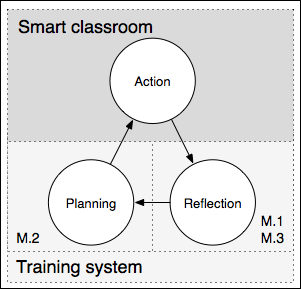
Gerritsen, Zimmerman, & Ogan (in press) Planning/Action/Reflection model
It's not impossible, but it's not easy. The point I want to make with this chapter is that there are some really helpful ideas in the IMPG, but that it (a) doesn't really tell us how to deliver training, and (b) sort of falls apart if any of its components are missing. So take this view of the higher education classroom, where there is almost no incentive to get training or to reflect on your teaching:
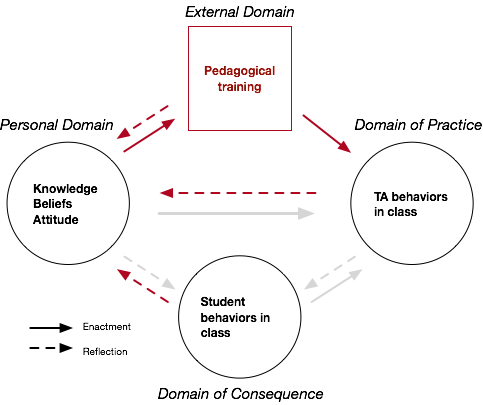
The red lines show the missing components. This is pretty much the case throughout colleges and universities, where people teach because they know the content, not because they have teaching skills.
Without training and reflection, there is basically no chance that an instructor is going to spontaneously get better. Some of them do, and some of them are naturally awesome, but for those that struggle (like I do), and don't have time to seek out support on their own, there needs to be something else in place.
Hence my cycle of planning, action and reflection. I won't get into what that is now. I'll just say that I hope this chapter can show how the needs of the actual classroom, as identified by the IMPG, can be addressed by my framework.
843 words on the outline today, with a fair bit of editing to yesterday's 268. At any rate, the first pass of the outline is done. I am pretty sure it's confusing and hand wavy. Luckily I have advisors who are smarter than I am that can look at it.
Tomorrow I begin drafting Chapter 2: Context of the Research. That's just the fancy name I gave to the related works chapter.
Clark and Hollingsworth's (2002) Interconnected Model of Professional Growth (IMPG)
And manhandle it until it conformed to this model of how I build technology-enhanced training systems:
Gerritsen, Zimmerman, & Ogan (in press) Planning/Action/Reflection model
It's not impossible, but it's not easy. The point I want to make with this chapter is that there are some really helpful ideas in the IMPG, but that it (a) doesn't really tell us how to deliver training, and (b) sort of falls apart if any of its components are missing. So take this view of the higher education classroom, where there is almost no incentive to get training or to reflect on your teaching:
The red lines show the missing components. This is pretty much the case throughout colleges and universities, where people teach because they know the content, not because they have teaching skills.
Without training and reflection, there is basically no chance that an instructor is going to spontaneously get better. Some of them do, and some of them are naturally awesome, but for those that struggle (like I do), and don't have time to seek out support on their own, there needs to be something else in place.
Hence my cycle of planning, action and reflection. I won't get into what that is now. I'll just say that I hope this chapter can show how the needs of the actual classroom, as identified by the IMPG, can be addressed by my framework.
843 words on the outline today, with a fair bit of editing to yesterday's 268. At any rate, the first pass of the outline is done. I am pretty sure it's confusing and hand wavy. Luckily I have advisors who are smarter than I am that can look at it.
Tomorrow I begin drafting Chapter 2: Context of the Research. That's just the fancy name I gave to the related works chapter.
Tuesday, May 22, 2018
Day 2 of dissertation writing
Since the post yesterday, I had a change in schedule come up and had to change a few things. My plan was to spend 6 hours writing today, but I had to move half of it to Thursday. (I am joining Marsha Lovett on a talk about this work coming up on Wednesday, and got a chance to collaborate with her this afternoon.)
The draft of Ch1 is done. Rough Introduction in the can. It took 834 words, so my estimate was close. It also went faster than I expected, at only about 90 minutes. This left me time to get started on outlining Ch5 ahead of schedule. And I am going to need it.
Ch5 is titled "A Framework for SmartPD," and I can now tell it's going to be quite hard to write. This framework is one of the primary contributions of my work. I've only written about it 3 times total. This has been over the past 6 months or so. For me—like a lot of folks I think—I generally come to understand my work best by writing about it. 3 times over 6 months, in my experience, is very little writing on a topic.
The main points I need to get across in this chapter are what SmartPD is meant to be, what the research tells me about how to plan for building toward it, and how Clark and Hollingsworth’s Interconnected Model of Professional Growth (2002) contributes to it. So it's a lot. And I'm not yet sure how it will all fit together.
I put down 268 words on Ch5, and also copy-pasted a lot of older text to draw from. I'll get back to it tomorrow and see if I can make any better sense of it.
The draft of Ch1 is done. Rough Introduction in the can. It took 834 words, so my estimate was close. It also went faster than I expected, at only about 90 minutes. This left me time to get started on outlining Ch5 ahead of schedule. And I am going to need it.
Ch5 is titled "A Framework for SmartPD," and I can now tell it's going to be quite hard to write. This framework is one of the primary contributions of my work. I've only written about it 3 times total. This has been over the past 6 months or so. For me—like a lot of folks I think—I generally come to understand my work best by writing about it. 3 times over 6 months, in my experience, is very little writing on a topic.
The main points I need to get across in this chapter are what SmartPD is meant to be, what the research tells me about how to plan for building toward it, and how Clark and Hollingsworth’s Interconnected Model of Professional Growth (2002) contributes to it. So it's a lot. And I'm not yet sure how it will all fit together.
I put down 268 words on Ch5, and also copy-pasted a lot of older text to draw from. I'll get back to it tomorrow and see if I can make any better sense of it.
Monday, May 21, 2018
Dissertation writing officially under way
As of today, five weeks later than I had planned, I have begun writing my PhD thesis. On the upside, I at least prepared over the past few months by outlining most of the chapters and building a daily writing plan. Now it begins.
My goal today was to write for 3 hours. I produced 1291 words drafting the first chapter. I probably have about 900 more to go before my first draft of Ch1 is done. I plan to complete that tomorrow and then write the outline for Ch5.
I decided to revive this blog space in order to write reflections on the process. It might help me stay on track if I think there's a remote possibility that someone I know could be paying attention. It also helps me express my online exhibitionism in a relatively low-impact kind of way, now that I have lost all interest in the dominant social networking site.
My goal today was to write for 3 hours. I produced 1291 words drafting the first chapter. I probably have about 900 more to go before my first draft of Ch1 is done. I plan to complete that tomorrow and then write the outline for Ch5.
I decided to revive this blog space in order to write reflections on the process. It might help me stay on track if I think there's a remote possibility that someone I know could be paying attention. It also helps me express my online exhibitionism in a relatively low-impact kind of way, now that I have lost all interest in the dominant social networking site.
Tuesday, August 11, 2015
The Reader of Games Books
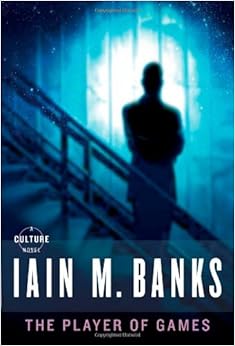
At only 50 pages, the setting for Banks' book includes a massive space habitat (e.g.) in a highly advanced society where people are so wealthy that no one ever has to labor, there is no crime, and society completely surrounds itself in games. Board games, in particular, are of the highest culture. The study and mastery of games and "game theory" are considered intellectual pursuits.
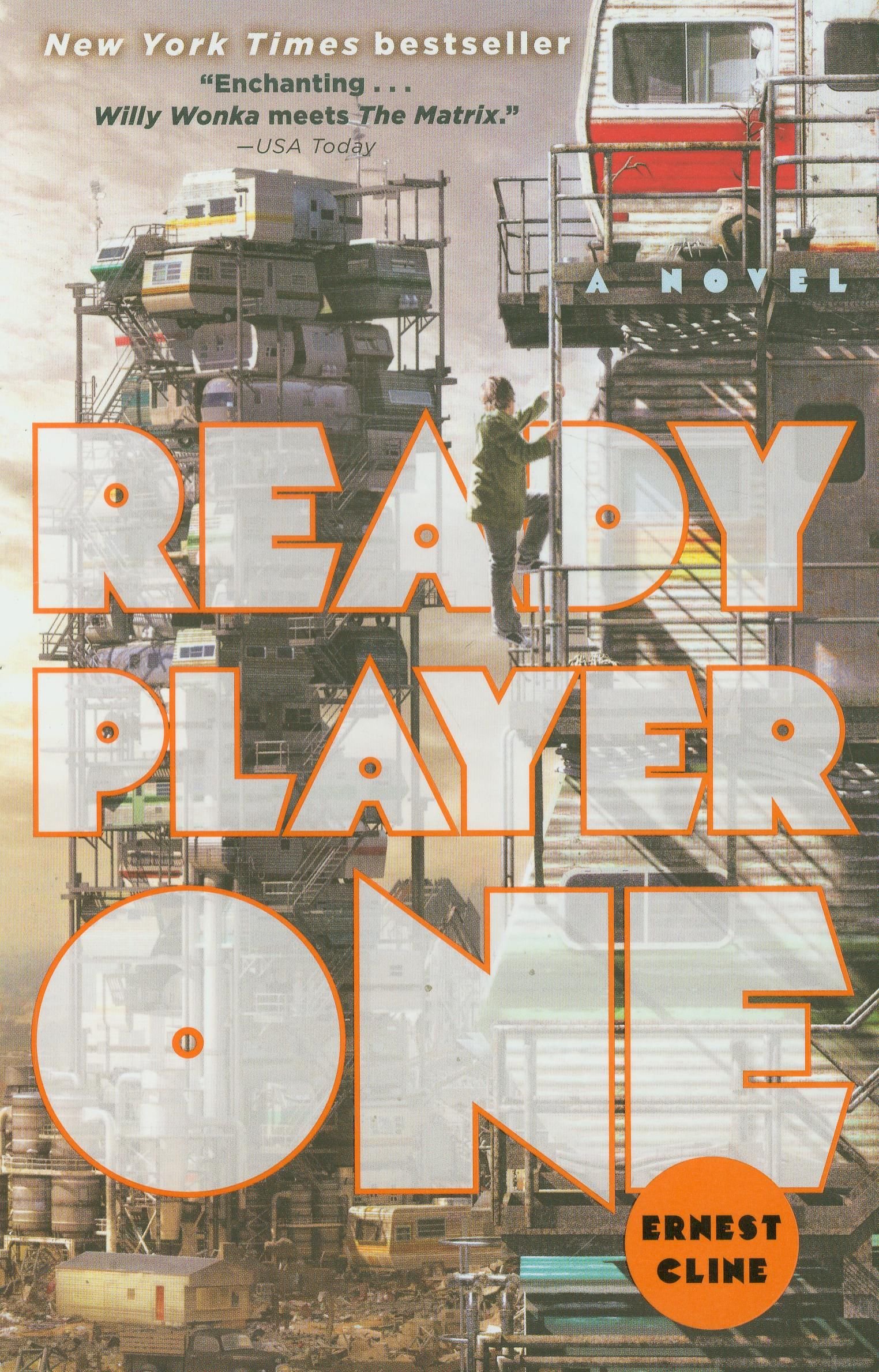
The interesting contrast between these two books is that Banks used a romantic sci-fi setting, popular at the time that he wrote it, where the future can be a peaceful and leisurely utopia. (Of course, not all is well under the surface, and the protagonist is already beginning to rub up against the sharp edges of his reality.) Cline's book, on the other hand, uses a postmodern setting, popular at the time that he wrote it, to show that the future can be a harsh and cumbersome dystopia. (Of course, not all is terrible. There is still love and honor and romance.)
This contrast between the two actually creates a complementary relationship, a braid of narratives running counter to the primary position of their own setting. Each books play an inverse role to the mechanics of the other.
Saturday, June 9, 2012
The Book of Pittsburgh 1:1-6
 |
| Wyoming? Wynot? |
Whereas cuticles are criminally abused, the car is furious packed and repacked, and coffee mugs are topped, we hereby move to Pittsburgh.
Tonight we are stopped in Cheyenne, because
we see absolutely no sense in speeding across the country. That means that a short 7 hours got us from
our doorstep in Utah to the I-80 Holiday Inn* in lower Wyoming. It’s not far, but everything feels different.
The newness of the move kicked in when we hit the 215 going
east out of South Salt Lake. This interchange
is only 10 minutes from where we lived for the last 3 years, but it’s a
direction I rarely take. That less
familiar view brought into focus some more expansive vistas: five-plus years of
dense urban neighborhoods, late-night deadlines, and no lack of lake effect. (To my Salt Lake friends, for most Americans
the term “lake effect” does not mean the stench of brine shrimp blowing into
the valley. It’s a cold, hard dump of
snow and ice launched from any number of Great Lakes—or so I have heard.) I have mixed thoughts on all of this, but my
feelings are fairly clear. There is a core
of confidence covered in a thin layer of anxiety. Wavering through this emotional sphere is an electromagnetic
field of what the Brazilians call saudade.
I will miss my mother’s good cheer, my sister’s passion, my
brother’s unique mixture of stoicism and compassion. My nieces and nephews will be near my
thoughts, and missed most of all. I
think about little Alejandra and her easy way of cuddling with uncle Toy-toy,
or Wyatt and his precocious knock-knock jokes.
I will miss talking Java with my dad, and having birthdays with his
wife and kids. Not least of all, there
are scores of baristas dotting the Wasatch Front who have set a high standard for
my expectations of service workers in Pennsylvania. (Yes, as a whole, these SLC punks out-perform
the baristas of Portland.—if only I could have had as good a cup of coffee.)
To ease the transition, we have a number of nesting plans. Vivian has already designed about 13 rooms
worth of decorative themes. Friday
nights will be Board Game Night for anyone interested in showing up. We have encouraged all of our loved ones to
get on Skype, and we’re planning a video blog of our new life…or at least the
silliest aspects of it which we can discover or invent. These will mostly be for the children and the
easily amused, you see.
My final thoughts tonight are for all of you that I did not
spend enough time with while I was in Salt Lake, or during my semi-regular
trips to Portland. I have not forgotten a
single one of my friends and loved ones, but that doesn’t mean I always called
you when I could have. My apologies for
this. My only excuse is that I was able
to devote enough time to my school work that I have now been invited to work in
one of the most exciting departments of one of the most innovative universities
in all the world. It was a rough trade,
but one of the main advantages of a PhD from Carnegie Mellon is going to be regular
travel to the cities which my favorite people inhabit, wherever in the world
you might be.
Friday, September 30, 2011
Intuition is fed by data.
This post is for my friend Rees, who's FB wall was beginning to burst with our comments. I've moved the conversation here to save his friends from the excessive verbiage.
In order to save the poor people who originally made comments on that post, I'll respond here.
I think there are two side to the question of how intuition is fed by data. The side which you're focusing on deals with constantly pressing the data for more answers. You're taking information and looking for as many different possible questions which can be applied to it. For example, say you were looking at a list of suicide rates by nation. One way to look at the data is to ask yourself questions like, "Why does Lithuania place first?" "Does Japan rank high because of cultural views on suicide?" "Why do so many Muslim countries fall lower on the list than Christian countries?"
These sorts of questions are great for coming up with research questions. But that's about as far as you can take it. Notice, however, that these speculative questions all rely to some extent on the intuition you already have about social dynamics. In the same breath that you're asking the question you are also formulating a speculation as to the answer. That is one way that data feeds intuition.
Another side to my notion that intuition thrives from data comes from an experimental viewpoint. Whether you're doing longitudinal studies or controlled experiments, the whole point of science is to come up with a question and then choose the observational method that will best answer it. You use a great deal of specificity at this level. You give everything a definition, and you ask discrete questions. For example, you might ask the question, "Does changes in political leadership have an effect on suicide rates?" Then you look for not one data set, but two. You take the historical documentation of the two questions and begin looking for statistical correlations. If you find a result, maybe that every time a country goes through a significant political shift (note: you have to operationalize both the terms 'significant' and 'political shift') then the suicide rate increases, you have found a correlation. That is not the same thing as finding a cause. But you've narrowed your search a little bit. In that way you have fed your intuition at least by now begin able to say, "Well, I don't know what's causing it, but I see that these two things tend to happen at the same time." That's more than you knew before, and it guides your later questions.
I should make it clear that I made up those results. I have no idea if political upheaval has anything to do with suicide rates. My intuition tells me that the two are unrelated. That doesn't mean much, but it's ok to talk about what I think might happen or what might be behind something.
My guess is that your intuition is already well-developed, but that you're just out of practice noticing it. There's nothing wrong with looking at things from different angles. But your intuition shouldn't be something you hide from yourself, or from anyone else. There's a risk of becoming blind to your own bias.
Wednesday, March 2, 2011
Spatial-only map to the U
This is a no-word map from the... well, I've said too much already. To advance the presentation, push the big arrow button on the bottom.
Subscribe to:
Posts (Atom)